WOOLF ARTS ARCHIVE

Blog

always in progress

Woolf in Circles: Can Akgümüş in Conversation with Mine Özyurt Kılıç
Can Akgümüş & Mine Özyurt Kılıç
15 October, 2026
Interview
In this edition of Woolf in Circles, the Woolf Arts Archive’s interview series, artist and curator Can Akgümüş joins Mine Özyurt Kılıç to explore the connections between photography, memory, time, and Virginia Woolf’s literary legacy. Their conversation reflects on past collaborations, the significance of the Woolf Arts Archive, and Akgümüş’s new artistic chapter in the United Kingdom.

Woolf in Circles: Coline Atterbury in Conversation with Mine Özyurt Kılıç
Coline Atterbury & Mine Özyurt Kılıç
16 September, 2026
Interview
In the first Woolf in Circles interview, Coline Atterbury discusses I’m Afraid of Virginia Woolf, Too, exploring creativity, bipolar disorder, and the shifting boundaries between admiration, identification, and obsession through Virginia Woolf.

Bu İnanılmaz Yaratma İhtiyacı: Ted Ollier ile Letterpress Sohbeti
Mine Özyurt Kılıç
10 May, 2026
Interview
This is the Turkish translation of an interview conducted by Mine Özyurt Kılıç with Ted Ollier on May 29, 2017, in Cambridge, Massachusetts. The English version of the interview is available here.

Colour Nestling into Page and Perception: Virginia Woolf’s “ Blue & Green”
Almina Altümsek
10 May, 2026
Essay
This essay examines Claire Nicholson’s 2023 special edition of Virginia Woolf’s “Blue & Green” as a contemporary artist’s book that revives Woolf’s early exploration of colour as a field of affective intensity, perception, memory, and time. Drawing on Woolf’s autobiographical writing, diaries, letters, essays, and her engagement with Post-Impressionist ideas of colour, the essay argues that colour in Woolf’s work operates not as mere description but as a structuring force that shapes atmosphere, bodily sensation, and imaginative perception. In “Blue & Green,” green and blue gain narrative agency: they move, spread, gather, close over forms, and organize the rhythm and temporality of the prose. By printing “Green” in green and “Blue” in blue, and by arranging the page through colour and white space, Nicholson’s edition extends Woolf’s experiment beyond language by making perception itself part of the reading experience.

Knutsen's Own Mark on the Wall
İrem Sezer
31 March, 2026
Essay
The text argues that reality does not simply consist of objects or people, but emerges through relationships and interpretation. Using Heidegger’s ideas of Dasein and aletheia, it reads Knutsen’s exhibition as a spatial unfolding of Woolf’s “The Mark on the Wall,” where truth is revealed only partially, through movement, fragments, and unconcealment. In this way, the exhibition becomes a phenomenological event in which the viewer experiences reality as something never fully grasped.

Bir Dokunuşun Eşiğinde (Salyangozun İradesi)
Şeyma Dinç Tosun
15 March, 2026
Short Story
"The Snail’s Will" is a story about a snail who leaves his hiding place on a rainy night and sets out in search of food. As he moves through the wet grass, the riverbank, and the dark path under the streetlamps, his hunger, pain, and patience shape his journey.
Scroll down for the English version.
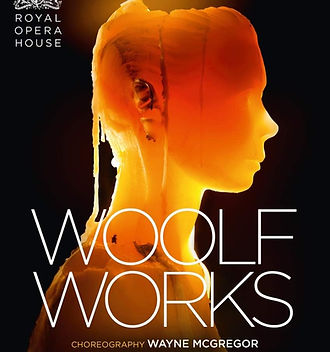
Moving with Woolf: Reflections on Woolf Works
F. Zeynep Bilge
01 March, 2026
Essay
The essay presents Woolf Works as an immersive experience that focuses not on retelling Mrs Dalloway, Orlando, or The Waves, but on how it feels to live inside Woolf’s consciousness. Through breath, memory, and movement, the ballet shows time folding back on itself, identity losing its boundaries, and memory pressing against the present. Woolf’s words are heard only twice, yet they echo through the space without overshadowing the dance. In the three parts — “I now, I then,” “Becomings,” and “Tuesday” — past and present move together, identity becomes fluid, and water imagery replaces drama. In the end, the ballet does not narrate consciousness; it stages its instability and leaves behind not a final image, but a sensation of Woolf still moving quietly within us.

Woolf'un Hayaleti Sahneye Çıkıyor
Z. Gizem Yılmaz Eriş
14 February, 2026
Essay
The essay argues that Woolf’s “ghost,” Judith, still moves through everyday writing and becomes powerfully embodied on stage in La Sœur de Shakespeare (2025, France, Compagnie Reme), a performance inspired by A Room of One’s Own that turns a single figure into the echo of women silenced across history. By linking Judith to forgotten lives and examples like Daphne, Margery Kempe, Margaret Cavendish, and Mary Somerville—and to the historical erasure of Shakespeare’s sister Joan—it frames “shadow” as both women’s exclusion from education, public life, and art, and a site of resistance. The piece ends as a call to keep Judith “on stage,” insisting that with material conditions (the “five hundred pounds” and “a room of one’s own”) women can write fully and step from shadow toward light.

No Room for a Chorus: Judith Shakespeare in Sound
Selenge Buçak
04 February, 2026
Essay
This essay argues that The Smiths’ 1987 track “Shakespeare’s Sister,” invoking Virginia Woolf’s parable of Judith Shakespeare in A Room of One’s Own, refuses to separate sonic form from lyrical content: the missing chorus, accelerating tempo, and strained vocals enact patriarchal violence and systematic foreclosure, producing “impossibility in form and in flesh.” Reading the song through materialist feminist theory (Grosz; Ahmed), it makes suppression experiential rather than intellectual—foreclosure felt in the listening body, in muscles that cannot settle and breath that cannot regulate—so Woolf’s insights become operational, “making systematic violence experiential rather than permitting intellectual distance.”

Happy Birthday [Immortal] Virginia!
Ahmet Özsever
25 January, 2026
Reflection
The passage reflects on Virginia Woolf’s lifelong search for self-definition—her recurring question, “Who was I then?”—and the way her writing models the courage to keep probing the self despite never reaching a complete answer. Marking her birthday, it ends as a tribute: happy birthday to “immortal” Virginia, whose greatest legacy may be teaching us to live by asking that question.
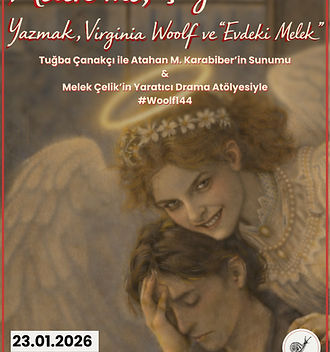
Melek mi, Şeytan mı? Yazmak, Virginia Woolf ve "Evdeki Melek"
The Woolf Arts Archive
19 January, 2026
Event
On Virginia Woolf’s 144th birthday, we’ll explore how the “Angel in the House” shows up as an inner voice that tells us to be nice, agreeable, and quiet—and how writing can break that spell. On Friday, 23 January 2026 at 13:00 in Kült Kavaklıdere (Yan Salon), Atahan Mahir Karabiber and Tuğba Çanakçı will give a talk, followed by Melek Çelik’s drama workshop where we’ll bring silences, swallowed words, and unfinished sentences onto the stage. It’s both a commemoration and a hands-on rehearsal for writing despite the ghosts.

On the Bench, Thinking Forward with Our Literary Mother
Ayşen Demir Kılıç
14 January, 2026
Essay
This essay argues that Virginia Woolf’s first bronze life-size statue on a bench in Richmond-upon-Thames (2022) functions as an interactive “counter monument” that removes hierarchy and distance and instead invites an eye level, transgenerational “emotional space” of empathy. It claims that through sitting beside Woolf, leaving books, offering shawls for warmth, taking photos and selfies, and touching the bronze as it wears down, visitors turn a formal monument into a personal, living presence and a physical record of human connection shaped by the public. Drawing on ideas of emotions as sticky and flowing and on the significance of the empty space on the bench, the essay suggests the work enables an ongoing exchange and an intellectual genealogy—transforming “a room of one’s own” into “our own”—so that the younger generation can “think back” and “think [forward] through [their] mothers.”

Walking with Woolf: A Visual Afterlife in Albani’s Oxford Street Tide
Fatma Gökçen Sırıt
12 January, 2026
Essay
The essay examines Virginia Woolf’s understanding of walking as an act that is “almost as natural and essential as thinking,” in which the rhythm of a step becomes the rhythm of consciousness, shaped by the visual field of the city. Focusing on Louisa Amelia Albani’s Virginia Woolf in the City: Oxford Street Tide pamphlet, it shows how Woolf’s image of Oxford Street as a “tide” that draws bodies into collective movement is translated into visual form, alongside moments of pause and introspection found in spaces such as the bookstore. Through these images, the essay argues that walking, whether compulsive or reflective, remains a fundamental method of perception in Woolf’s work and its artistic afterlife, where to walk is to gather impressions, to think, and to see the modern world in motion.

Tracing the Spirals: Woolf’s Archive of Being
İrem Kavallıgil
04 January, 2026
Essay
"Tracing the Spirals: Woolf’s Archive of Being" examines Virginia Woolf’s lifelong sensitivity to memory, space, and experience through the recurring metaphor of the snail and its widening spiral. Beginning with Woolf’s 1904 visit to the Brontë Parsonage, the essay argues that Woolf conceives places, objects, and houses as living archives that absorb sensations, emotions, and “moments of being.” Reading Woolf alongside Gaston Bachelard and To the Lighthouse, the text shows how material spaces preserve human presence beyond life itself. This archival rhythm—of recording, returning, and enduring—extends into contemporary artistic practices that trace Woolf’s legacy by transforming lived experience into ever-expanding creative spirals.

The WAA Symposium
The Woolf Arts Archive
18 March, 2025
Symposium
On March 6, 2025, Woolf Arts Archive held its first major public symposium in Ankara—hosted by TED University’s English Language and Literature Department and supported by TEDU WIL—bringing together scholars, artists, and theatre practitioners to discuss Virginia Woolf’s lasting influence across art forms. The event featured talks connecting Woolf’s cultural legacy with themes relevant to International Women’s Day and culminated in the archive’s third Turkish staged reading of Freshwater: A Comedy.

#Woolf142
The Woolf Arts Archive
25 January, 2024
Event
On January 25, 2024, Woolf’s 142nd birthday was marked with an online seminar led by Prof. Dr. Mine Özyurt Kılıç and Dr. Azime Pekşen Yakar, celebrating both Virginia Woolf and painter Suzanne Bellamy. Centered on Bellamy’s Woolf and the Chaucer Horse, the event explored the painting’s medieval-modernist symbolism, portraying Woolf riding Chaucer’s horse as an emblem of movement, literary authority, and women’s writing—echoing themes from A Room of One’s Own.

#Woolf143
The Woolf Arts Archive
25 January, 2025
Event
The Woolf Arts Archive invites art and literature enthusiasts to a festive #Woolf143 event at Ka Atölye (Ankara): a site-specific stage reading of the new Turkish translation of Virginia Woolf’s only play, Freshwater: Bir Komedi, held alongside a photography exhibition on darkness and night workers.

Beginning a New Year
Mine Özyurt Kılıç
01 January, 2025
Reflection
This text reflects on Virginia Woolf’s diary entry of 6 January 1925, offering an intimate portrait of her everyday life, creative process, and emotional outlook at the age of forty-four. Moving between domestic concerns, social gatherings, walks, reading, and the revision of Mrs Dalloway, the entry reveals Woolf’s method of capturing life through fragments and impressions rather than linear plot. Most notably, it emphasizes her deep appreciation for friendship and communal life, foregrounding her belief that “warm friendly feelings” are essential to both living and artistic creation, a sensibility that underpins her modernist vision of truth as a constellation of lived moments.

Snail around the Flowerbed of Literature: The Hogarth Press' Call to Slowness
Mine Özyurt Kılıç
01 November, 2024
Essay
This essay explores the symbolic significance of the snail in Virginia Woolf’s early works, particularly in “The Mark on the Wall,” and “Kew Gardens,” and the publications of the Hogarth Press. Woolf’s portrayal of the snail embodies a philosophy of slow contemplation amidst the rapid and standardizing forms of modern existence. Symbolizing a mode of deep thinking and attentive observation, the snail not only invites readers to engage in a deliberately slow approach to Woolf’s Modernist texts, but also prompts readers to attend to minutiae of everyday life and moments of being. Through literary analysis of Woolf’s artistic mission that advocates for a slower and deeper engagement with literature, and examination of the typesetting process at the Hogarth Press, this study illuminates the relevance of the snail as an emblem of slowness within both Woolf’s Modernist texts and the impetus behind the Hogarth Press.